What Art Historical Movement Was Jackson Pollock Apart of
"Information technology is a widely accepted notion amongst painters that it does not matter what 1 paints as long every bit it is well painted. This is the essence of bookish painting. However, there is no such thing as good painting near nothing."
1 of 8

"To us, art is an adventure into an unknown world of the imagination, which is fancy-gratuitous and violently opposed to common sense."
"Freeing ourselves of the obsolete props of an outmoded and antiquated legend .. freeing ourselves from the impediments of memory, clan, nostalgia, fable, and myth that have been the devices of Western European painting."
3 of 8

"Where the Erstwhile Masters created an illusion of space into which one could imagine walking, the illusion created by a Modernist is 1 into which one tin await, can travel through, only with the eye."
"At a certain moment the canvas began to appear to one American painter after another as an arena in which to deed - rather than as a space in which to reproduce, re-design, analyze, or 'express' an object, actual or imagined. What was to go on the canvas was not a motion-picture show but an upshot."
"Every so oftentimes, a painter has to destroy painting. Cezanne did it, Picasso did it with Cubism. Then Pollock did information technology. He busted our thought of a picture all to hell."
6 of 8

"The large format, at ane accident, destroyed the century-long tendency of the French to domesticize modern painting, to make it intimate. We replaced the nude daughter and the French door with a modern Stonehenge, with a sense of the sublime and the tragic that had not existed since Goya and Turner"
7 of eight

"Because of their lofty ideals, the showtime generation who formed The New York School are ofttimes referred to as the 'heroic' generation of American artists. Inventing new images and new techniques, they searched for universal symbols non limited to whatever specific time or place."
viii of 8
Summary of Abstruse Expressionism
"Abstract Expressionism" was never an platonic label for the movement, which adult in New York in the 1940s and 1950s. It was somehow meant to encompass not just the work of painters who filled their canvases with fields of color and abstract forms, simply also those who attacked their canvases with a vigorous gestural expressionism. Notwithstanding Abstract Expressionism has become the nigh accepted term for a group of artists who held much in common. All were committed to art as expressions of the self, born out of profound emotion and universal themes, and most were shaped by the legacy of Surrealism, a movement that they translated into a new style fitted to the post-war mood of anxiety and trauma. In their success, these New York painters robbed Paris of its mantle as leader of modern art, and set the stage for America'due south say-so of the international art world.
Key Ideas & Accomplishments
- Political instability in Europe in the 1930s brought several leading Surrealists to New York, and many of the Abstract Expressionists were profoundly influenced past Surrealism'due south focus on mining the unconscious. Information technology encouraged their interest in myth and archetypal symbols and it shaped their agreement of painting itself as a struggle betwixt self-expression and the chaos of the hidden.
- Almost of the artists associated with Abstract Expressionism matured in the 1930s. They were influenced by the era's leftist politics, and came to value an fine art grounded in personal experience. Few would maintain their earlier radical political views, simply many continued to adopt the posture of outspoken avant-gardists.
- Having matured equally artists at a time when America suffered economically and felt culturally isolated and provincial, the Abstract Expressionists were later welcomed equally the beginning authentically American avant-garde. Their art was championed for being emphatically American in spirit - awe-inspiring in calibration, romantic in mood, and expressive of a rugged individual liberty.
- Although the movement has been largely depicted throughout historical documentation every bit ane belonging to the paint-splattered, heroic male person artist, at that place were several important female Abstract Expressionists that arose out of New York and San Francisco during the 1940s and '50s who now receive credit as elemental members of the canon.
Overview of Abstract Expressionism
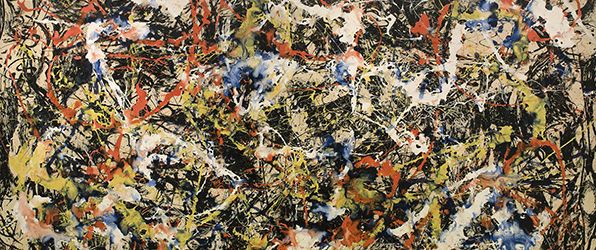
In 1943 the noted art collector and gallerist Peggy Guggenheim deputed Jackson Pollock to pigment a mural for her apartment antechamber. Though Landscape (1943) was the outset commission and large scale work for the then unknown creative person, he procrastinated for months, supposedly completing it in all night session just before Guggenheim'due south deadline. The painting launched his career as the leading artist of the then emerging Abstract Expressionism, and the story of its inception became part of his legend and myth.
Cardinal Artists
-

Jackson Pollock was the well-nigh well-known Abstract Expressionist and the key example of Activeness Painting. His work ranges from Jungian scenes of primitive rites to the purely abstract "drip paintings" of his later career.
-

Willem de Kooning, a Dutch immigrant to New York, was one of the foremost Abstract Expressionist painters. His abstract compositions drew on Surrealist and figurative traditions, and typified the expressionistic 'gestural' style of the New York School.
-

Mark Rothko was an Abstract Expressionist painter whose early interest in mythic landscapes gave way to mature works featuring large, hovering blocks of colour on colored grounds.
-

Helen Frankenthaler was an American abstract painter in mid-twentieth-century New York. Along with Morris Louis and Kenneth Noland, Frankenthaler is considered a pioneer in the practice of Color Field painting.
-

Clyfford Nonetheless was a leading first-generation Abstract Expressionist. His mature works are big-scale paintings with gaping chasms and stains of jagged colour, oftentimes in night earth tones.
-

Lee Krasner was an American abstract painter and a prominent first-generation Abstruse Expressionist. A student of Hans Hofmann'due south, and a pioneer in the all-over technique of painting that later influenced Colour Field artists such every bit Helen Frankenthaler, Morris Louis, and her hubby, Jackson Pollock.
-

German-born American painter, art teacher and theorist. Hofmann matured as an artist in 1904-14 in Paris, where he met many of the greatest artists of that time. Later he emigrated to America in the early on 1930s, he enjoyed a prominent career as a teacher, powerfully influencing many Abstract Expressionists with his understanding of European modernism.
-

Barnett Newman was an Abstruse Expressonist painter in New York who painted large-scale fields of solid color, interrupted by vertical lines or "zips." His sometimes narrow or boxy canvases, part painting and part sculpture, were influential for Minimalism.


Do Non Miss
-

After the say-so of Abstract Expressionism a grouping of artists with disparate styles and approaches pointed the fashion frontwards.
-

The Washington Color Schoolhouse refers to a group of painters including Noland, Louis, and Truitt. Their piece of work is marked by the presence of color areas, washes, and geometric designs that emphasized the two-dimensional surface of the film plane and its lack of reference to whatever subject matter.
-

A tendency within Abstruse Expressionism, distinct from gestural abstraction, Color Field painting was developed past Barnett Newman, Mark Rothko, and Clyfford Still in the late 1940s, and developed further by Helen Frankenthaler and others. It is characterized past large fields of color and an absence of any figurative motifs, and frequently expresses a yearning for transcendence and the space.
-

Action Painting was a term coined past art critic Harold Rosenberg to refer to the gestural and somewhat existential mode of Abstract Expressionism, often characterized by drips, flung paint, and rapid, spontaneous strokes by the artist. In this view the painting is a tape of the artist'south activities over time.
-

Responding to the atrocities and traumas of World War II, the artists associated with Art Informel embraced abstraction and gestural techniques.
-

The Bay Expanse Figurative Movement emerged in the 1950s and 60s effectually the San Francisco Bay. Heavily influenced by the colour fields and painterly brushwork of Abstract Expressionism, they later moved away from abstraction in a more figurative direction.


Important Fine art and Artists of Abstract Expressionism

1957-D-No. 1 (1957)
In the early 1940s Clyfford Still, similar many other artists of the time, was primarily a representational painter, evoking moody dark scenes in somber colors. Past the mid 1940s his work began to change with the appearances of dashes and jags of colored lines atop his paintings. This marked his ain shift into Abstract Expressionism as a non-objective painter interested in juxtaposing different colors and surfaces into a diverseness of formations.
Although known for existence 1 of the prominent Colour Field painters, Nonetheless'southward hot bursts and crackly lines of vivid hues that conjure tears and gashes were singled-out from say Rothko's more than simplified washes of color, or Newman's sparse lines. This tin exist seen in 1957-D-No. 1, a large piece of work that recalls natural shapes and phenomena reminiscent of cave stalagmites, caverns, and other mysterious elements that prevarication just beneath the surface of our everyday conscious recognition. The relationships within Still's compositional ingredients, of foreground and background, bring to mind life'south trip the light fantastic betwixt light and nighttime - something Still loved expressing, a self-described "life and decease merging in fearful union."

Autumn Rhythm (Number 30) (1950)
The piece is exemplary of Pollock's famous "drip" works in which paint was poured, splattered, and applied by the artist in an extremely concrete fashion from above to a sheet which lay on the ground. This process of expressing an internal emotional turbulence through gesture, line, texture, and limerick represented a quantum for Pollock in his career and helped put the New York School of painters on the map. These paintings became the impetus for critic Rosenberg'southward coining of the term Activeness Painting. And this unlikely combination of adventure and control became tantamount to Abstruse Expressionism'southward evolution.

Excavation (1950)
Earthworks is one of Willem de Kooning'due south most renowned works, and a true depiction of his Abstruse Expressionist mode. In it, we see a multitude of outlined forms that are abstractions of familiar shapes right on the periphery of recognition: fishes, birds, jaws, eyes and teeth. De Kooning has said of his work, "I paint this way because I tin can keep putting more and more things in - drama, acrimony, pain, love, a effigy, a equus caballus, my ideas about space." After this frenzied pile up of imagery, de Kooning would and so, with signature chaos and deliberation, remove, scrape and add paint until he unearthed what he wanted. The resulting slice presented a truthful excavation of the artist'due south mind and movements in the moment.
De Kooning remains ane of the well-nigh seminal gestural "activity painters" who worked often with wide brushstrokes and in light, pastel palettes. He sought actuality of experience, non only in the making of his paintings but also in the representation of the experience on sail.
Useful Resources on Abstract Expressionism
Special Features
Books
video clips
articles
More than
Books
The books and articles below constitute a bibliography of the sources used in the writing of this page. These also advise some attainable resources for farther inquiry, especially ones that tin be establish and purchased via the internet.
-
Abstract Expressionism (World of Art, twond edition) (2015)
By Debra Bricker Balken
-
Abstract Expressionism: A Globe Elsewhere (2010)
By David Anfam
-
Ninth Street Women: Lee Krasner, Elaine de Kooning, Grace Hartigan, Joan Mitchell, and Helen Frankenthaler: 5 Painters and the Motion That Inverse Modern Art
Past Mary Gabriel
-
Abstract Expressionism: The International Context (2007)
Focus on movements influence on international art scene / By Joan Marter, David Anfam
-
Reading Abstract Expressionism: Context and Critique (2005) Our Pick
A choice of readings including influential statements by Rothko, Motherwell, Pollock, and Newman as well as commentary past various critics. No reproductions of works / Past Ellen Thou. Landau
-
American Abstruse Expressionism of the 1950s: An Illustrated Survey (2003)
88 artists are represented with statements in their own words and a biography. / Past Marika Herskovic
-
Abstract Expressionism: Other Politics (1999)
History of the move past investigation of other, largely-ignored artists - people of color, women, gays, and lesbians. / By Ann Eden Gibson
-
The New York School: A Cultural Reckoning (1992) Our Pick
Past Dore Ashton
Content compiled and written past The Art Story Contributors
Edited and published by The Fine art Story Contributors
"Abstract Expressionism Movement Overview and Analysis". [Internet]. . TheArtStory.org
Content compiled and written by The Fine art Story Contributors
Edited and published by The Art Story Contributors
Available from:
Starting time published on 22 Nov 2011. Updated and modified regularly
[Accessed ]
theriaultformien1951.blogspot.com
Source: https://www.theartstory.org/movement/abstract-expressionism/
0 Response to "What Art Historical Movement Was Jackson Pollock Apart of"
Post a Comment